
Interview: Aaron Baker

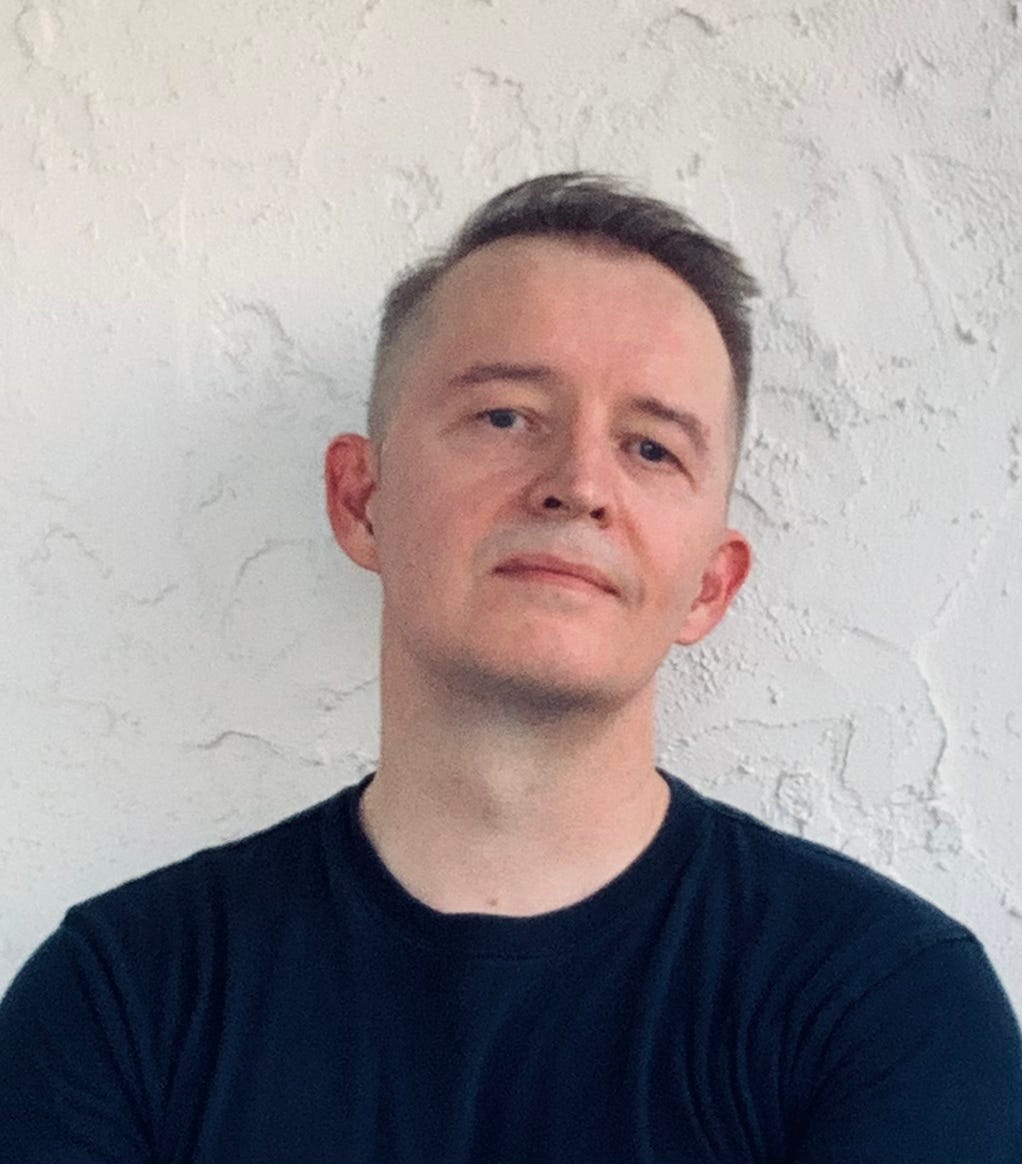
Aaron Baker is the author of three books of poetry: American Experiment: A Poem, Posthumous Noon, and Mission Work. From Graham, Washington, he’s lived in Papua New Guinea, Mexico, and Germany, and currently divides his time between Tucson and Chicago, where he’s a Professor of English and directs the Creative Writing Program at Loyola University Chicago. His awards include the Shenandoah/Glasgow Prize for Emerging Writers, a Wallace Stegner Fellowship from Stanford University, the Breadloaf/Bakeless Prize (selected by Stanley Plumly) and the Barry Spacks Poetry Prize (selected by Jane Hirshfield).
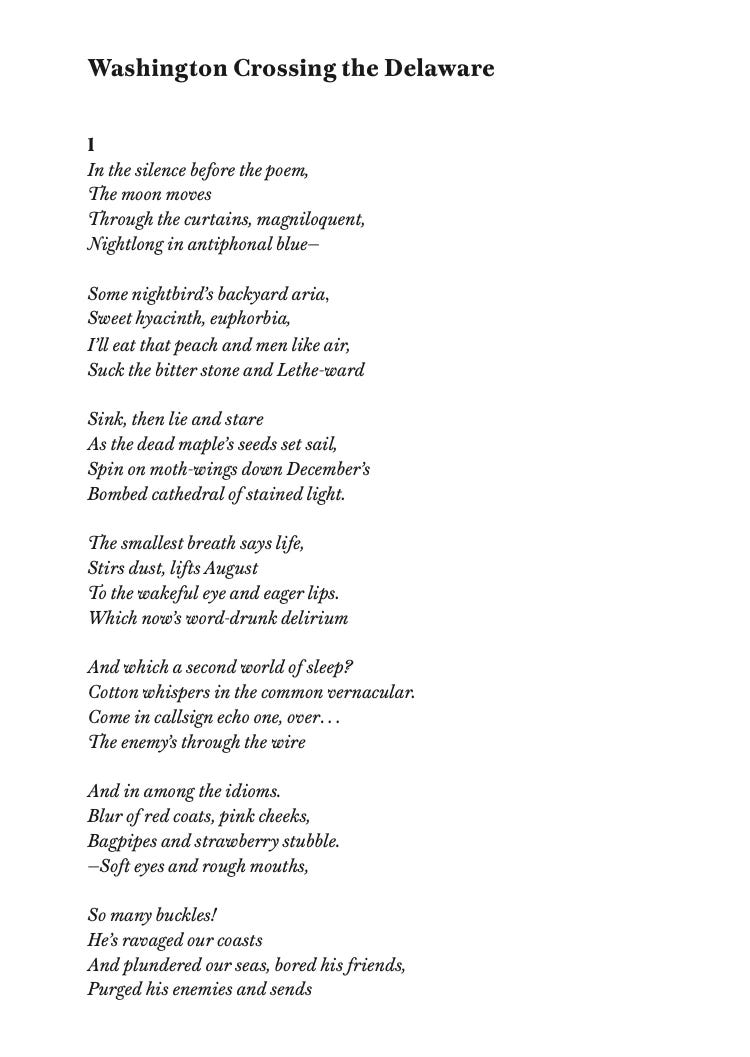
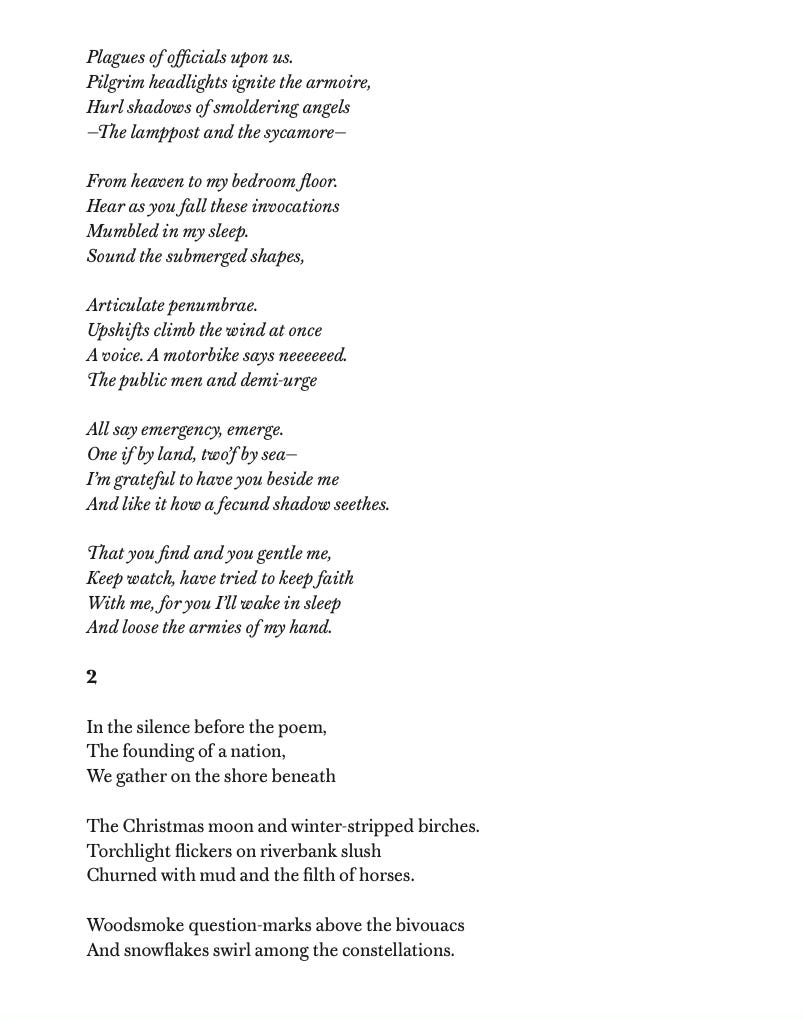
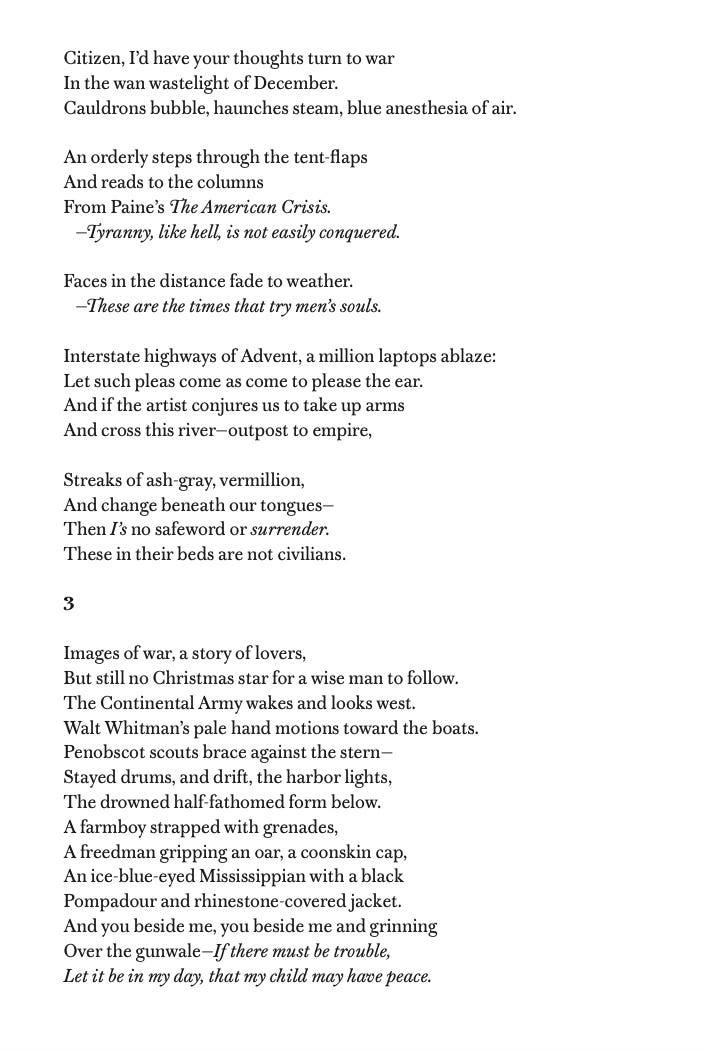
“Washington Crossing the Delaware,” from Baker’s forthcoming book, American Experiment, begins with the painting by Emanuel Leutze from 1851, but immediately becomes about the process and culture of poetry-making in 2026.
The first section begins with nervous, slant-rhymed quatrains set among the pastorals and high culture of modernism, then the second moves into a freer, more contemplative analysis of the citizen and their voice in the coffeeshop working on their writing. The third, a phantom-like sonnet form, considers the forms blood and family have been sacrificed to engage with the work-in-progress American experiment.
SS: What is the function of poetry?
AB: Poetry can be put to any purpose language can, so it’s hard to single out and point to a single function. It can be anything from justifying god’s ways to man (Milton) to just helping socially awkward people get laid (most everyone else).
I like what Wallace Stevens said about this, that poetry makes the visible a little hard to see. This can be in the manner of corrective lenses though. A little distortion, a little bending of the light around the edges of the medium of language, and therefore of thought, doesn’t have to be a bad thing. It can be the kind of distortion that helps us perceive certain things more accurately, or maybe even percieve new things altogether. At the extreme end, that’s the aim of the real visionaries like Blake, Keats, Dickinson, Hart Crane, Gluck, C.Wright, CD Wright, some others. Ultimately though the poem itself either finds or creates its function. “New thresholds,” as Hart Crane put it, and “new anatomies.”
At the end of the day, fortunately we’re only talking about poems here. If they don’t perform the function you wanted them to, it’s legal to delete, shred, drown them in the bathtub, or give them a one star Amazon review.
SS: What is the hardest thing about writing poetry?
AB: Weighing this word against that word, balancing this formal element against that one, raising the energy in one place while suppressing it in another, and all while trying to remain alert in the midst of this maelstrom of sounds and images as you stir the boiling pot of language for something promising and orignal to break loose, sometimes by pure accident, and come floating to the surface. I guess my insight here is that the hardest thing about writing poetry is finding the right words. Thanks for that valuable insight, Aaron! It is though. Much of it’s just putting in good old-fashioned hard work.
Another challenge, and one I’ve been thinking about a lot with my third book of poems about to drop, is the need to keep growing, changing, and not just repeat what I’ve already done just because I already know how to those things and it would be easier.
The hardest things about writing poetry are also the most rewarding.
SS: What would make poetry better or healthier?
AB: Writing better poems is the best way. If we’re teachers, editors, or in proximity to other poets, helping to set the conditions for them to also write better poems is another one,
I really think there should be opportunities for early career poets to achieve some significant recognition for individual poems without having to first pass through all the chokepoints of graduate degrees and first book contests. A couple friends and I have batted around the idea of poetry site that at regular intervals would feature just one poem by a younger or early-career poet alongside several incisive critical reactions from more established poets/critics of mixed and even opposed tastes and backgrounds. It’s one idea anyway.
SS: What non-poetry book should poets read?
AB: I’d suggest O My Land, My Friends: The Selected Letters of Hart Crane (edited by Langdon Hammer), but if there’s any poet you love whose letters you can get ahold of, you should absolutely read them. Seeing these poets who you probably first encountered in anthologies or classrooms talking and behaving just like you do in your emails and dms with friends is both educational and a lot of fun.
SS:Which poet do you think is underrated?
AB: Since I’m already talking about him, Hart Crane! For me his work is filled with a lot of little first glimpses through the fog of what looks to me like a Mt Everest sized volcano of dormant linguistic power. I think Crane’s reputation got flash frozen at some point in the critical environment of the 1930s, complete with all its weird prejudices and insularity. In my upcoming book length poem American Experiment (out in a few weeks from Texas Review Press), Walt Whitman may be my guide through the underworld, but my heart still belongs to Hart Crane.
I’m happy to offer the Summer 2026 series of Guided Poetry Reading Groups. You can register for them here: https://www.seansingerpoetry.com/join-book-club
Tell your friends!
The Thursday meetings will be: 10 am-12 pm EDT
May 21, June 25, July 23, August 27
The Sunday meetings will be: 11 am-1 pm EDT
May 24, June 28, July 26, August 30
THURSDAY
Bert Meyers, On the Life and Work of an American Master (Pleiades Unsung Masters Series, 2023) [Please note Meyers’s book is out-of-print. I will provide a PDF version of this text because it can be hard to find.]
Richard Siken, I Do Know Some Things (Copper Canyon, 2025)
Jean Garrigue, Selected Poems (Univ. of Illinois Press, 1992)
Minnie Bruce Pratt, Magnified (Wesleyan, 2021)
SUNDAY
Yusef Komunyakaa, Magic City (Wesleyan, 1992)
Jack Gilbert, The Great Fires (Knopf, 1994)
Emily Wilson, Burnt Mountain (Univ. of Iowa Press, 2025)
Carol Frost, I Will Say Beauty (TriQuarterly, 2003)
Excellent! Thank you. And, everyone should sign up for one of the Guided Reading Groups!
“…there should be opportunities for early career poets to achieve some significant recognition for individual poems without having to first pass through all the chokepoints of graduate degrees and first book contests”
Ummmm, these things do exist all over America outside of academia. I received a lot of recognition, as many of my other Poet friends, none of us with degrees in writing (more likely a degree in sociology or education or no degree at all.) Some of them have been Poets Laureate in their city in, their state or for their side of the Rocky Mountain range. Get yourself out of academia and see how the world of organic poetry works versus the world of academic poetry. You might surprise yourself at how much creatives take charge of their lives and make things happen for themselves other creatives, don’t limit or define your life through the academic lens. There is so much more for every Poet to see feel here touch taste and write.