
Interview: Jane Huffman

I am introducing a new feature of The Sharpener, a series of monthly interviews with contemporary poets. The first is Jane Huffman.
Jane Huffman is the author of Public Abstract, winner of the 2023 American Poetry Review/Honickman First Book Prize. She is a doctoral student in English and Literary Arts at the University of Denver. Her poems have appeared in The Nation, Poetry Magazine, The New Yorker, The Atlantic, and elsewhere. She was a 2019 recipient of the Ruth Lilly and Dorothy Sargent Rosenberg Fellowship from the Poetry Foundation. She is currently associate editor at Denver Quarterly. Instagram: @ somuchdepends
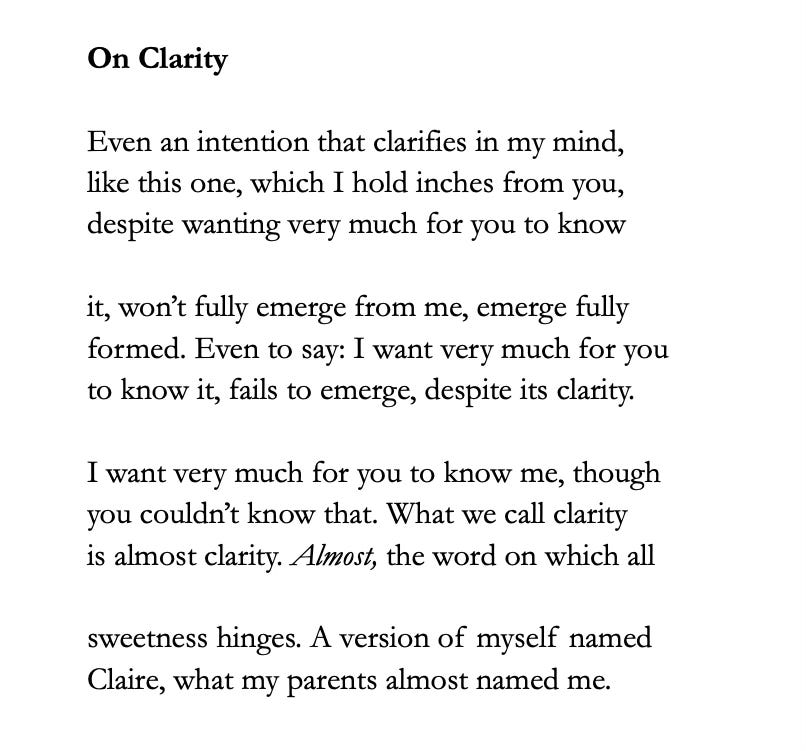
Huffman’s poem “On Clarity” shows her high facility with form that is in service of bringing the motions of the mind onto the page. The poem uses elements of a stretchy blank verse with the ghazal. Strikingly, the poem uses no concrete images.
It’s a meditation and its abstract thinkingness belies a simplicity. The notion of clarity, or being clear (with a reader, with others, or with oneself) requires kneading of thought. Thus, the poem uses repetition. “Emerge,” “clarity,” and “named” repeat, but an unexpected positions in the 11 lines. The poem is not only about selfhood, but the messiness of understanding the self. The poem is psychological and it shows great style in its expression of psychological sturdiness.
SS: What is the function of poetry?
JH: Functionality eludes me, except that like all art, poetry is a way of engaging with the consciousness of another person, or at least an aspect or impression of it. In that way, it produces communication. Poetry also expands my understanding of language, which demands constant attention and recalibration. Both seem fundamental to the human experience.
SS: What is the hardest thing about writing poetry?
JH: This is a challenging question. Intellectually, the hardest part of poetry is making it new, trying to write in a way that is continually surprising to myself. I want to finish a poem without completely understanding it, how its component parts enmesh and hold together. If I knew exactly what I was thinking, feeling, talking about, I would probably work in a different genre. It is difficult to suspend myself, and my reader, in uncertainty, in process. I always hope the effect is a kind of negative capability and not befuddlement (a fine line). Stringing that needle is what keeps me doing it.
SS: What would make poetry better or healthier?
JH: Affordable healthcare.
SS: What non-poetry book should poets read?
JH: St. Augustine’s Confessions, a must for poets interested in self-reflection. I’ve been reading it in an online class with Garth Greenwell, who has introduced me to Charles Taylor’s notion of “radical reflexivity.” Milkman, by Anna Burns, comes to mind. But those are easy answers. In my PhD program, I recently took a class co-taught by a biologist and a medievalist in which we studied early medieval monastic texts in conversation with current literature about the human sensorimotor systems. I was totally, totally out of my depth all quarter, but the texts we read gave me new diction for writing about the mind and body. Poets should read far afield.
SS: Which poet do you think is underrated?
JH: Susan Stewart, though not in my house. Nicanor Parra, in the U.S. That’s two.
For further reading:
Huffman, Jane. Public Abstract: Poems. Philadelphia: American Poetry Review, 2023. [Buy at Bookshop]
I love that poem & Jane's insights. Thank you!
What a good idea! More interviews! And now to go looking for more Jane Huffman